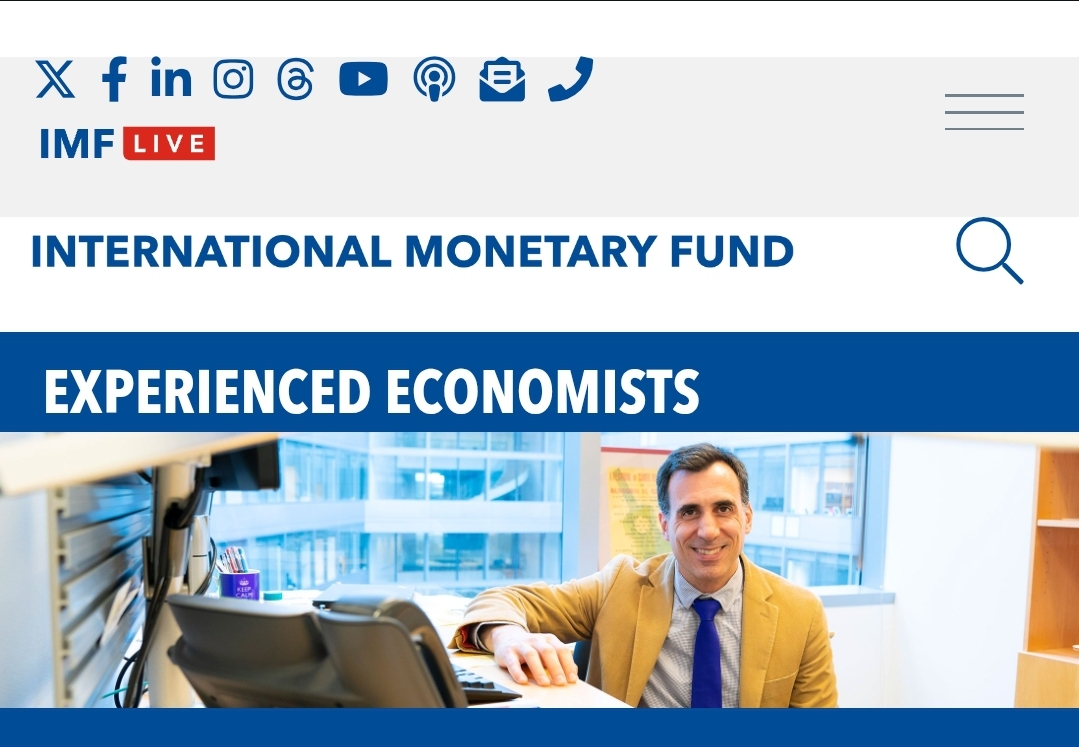

IMF Experienced Economists Jobs 2026 offer experienced macroeconomists and economic specialists an opportunity to work with the International Monetary Fund (IMF) and contribute to global economic policy, research, country programs, and macroeconomic stability.
The IMF Experienced Economist recruitment is designed for professionals with advanced degrees and substantial experience in macroeconomic policy, quantitative analysis, econometrics, country surveillance, research, or related areas. Successful candidates can join one of the world’s largest teams of economists focused on macroeconomics.
If you are an experienced economist looking for an international career, the IMF Experienced Economists Jobs 2026 may provide an opportunity to work on challenging economic issues affecting IMF member countries around the world.
IMF Experienced Economists Jobs 2026 – Overview
- Organization: International Monetary Fund (IMF)
- Position: Experienced Economist
- Field: Economics, Macroeconomics, Monetary Economics, Financial Economics, Public Finance, International Trade, Econometrics
- Degree Required: Master’s or PhD
- Experience: Relevant professional experience required
- Work Area: Macroeconomic policy, country surveillance, economic research, policy design, quantitative analysis, and capacity development
- Location: IMF offices and assignments as applicable
- Recruitment: Vacancies are advertised regularly
- Application Platform: IMF Workday
- Official Organization: International Monetary Fund
About IMF Experienced Economists Jobs
As an Experienced Economist at the IMF, you would become part of a large international team of economists focused on macroeconomics.
IMF economists work on a wide range of challenging policy issues. Their responsibilities can include economic analysis, policy formulation, program design, research, and capacity development designed to help IMF member countries address specific economic challenges.
The IMF Experienced Economist role also involves collaboration with colleagues throughout the IMF and with government authorities, institutions, and economic leaders around the world.
This international and collaborative environment allows economists to develop practical solutions to changing global economic challenges.
What Does an IMF Experienced Economist Do?
The responsibilities of an IMF Experienced Economist depend on whether the economist works in an area department or a functional department.
1. Area Department Economist
An economist working in an IMF area department may be assigned to one or two countries or to a specific geographic region.
Related Article:IOM Development Fund Internship 2026 in Geneva, Switzerland | Apply Now
The role can involve:
- Analyzing fiscal policy
- Analyzing monetary policy
- Examining exchange-rate policies
- Promoting macroeconomic stability
- Studying macro-financial linkages
- Assessing economic governance
- Examining fiscal sustainability
- Examining external debt sustainability
- Developing approaches to regional trade liberalization
- Supporting broader trade liberalization
- Analyzing economic developments in member countries
- Advising policymakers on economic challenges
Area department economists therefore play an important role in helping countries understand economic risks and develop appropriate macroeconomic policies.
2. Functional Department Economist
An economist working in a functional department may focus on a particular economic field or area of expertise.
Responsibilities may include:
- Providing economic advice
- Developing economic policies
- Conducting research
- Delivering teaching
- Supporting policy-related research
- Building economic expertise in member countries
- Working with area department economists
- Assessing how current global economic issues affect IMF member countries
Functional economists may also contribute to the IMF’s world-class research on policy-related issues and help shape the organization’s work.
IMF Experienced Economist Eligibility Criteria
To apply for IMF Experienced Economists Jobs, candidates should meet the required academic, professional, technical, and communication qualifications.
Academic Requirements
Applicants should have an advanced degree, either a master’s degree or PhD, in macroeconomics or a related field.
Relevant fields include:
- Macroeconomics
- Monetary economics
- Financial economics
- Public finance
- International trade
- Econometrics
- Related economics fields
Professional Experience Requirements
Applicants should have relevant professional experience at the national or regional level in areas such as:
- Macroeconomic policy
- Quantitative techniques
- Country surveillance
- Economic policy analysis
- Economic research
This experience is usually gained in organizations such as:
- Central banks
- Ministries of finance
- International financial institutions
Experience in a research institute or academia may also be considered when combined with exposure to macroeconomic policymaking.
IMF Experienced Economist Experience Requirements
The IMF provides specific experience guidelines depending on the applicant’s degree.
PhD Candidates
Applicants with a PhD should generally have:
3 to 10 years of relevant work experience.
Master’s Degree Candidates
Applicants with a Master’s degree should generally have:
7 to 14 years of relevant work experience.
Candidates should also demonstrate the technical expertise necessary to conduct economic analysis and support policy formulation.
Required Skills for IMF Experienced Economists
Successful candidates for IMF Experienced Economist positions should demonstrate strong technical and interpersonal skills.
Important qualifications include:
- Strong quantitative modeling skills
- Strong econometrics skills
- Ability to use quantitative analysis for economic policy
- Strong economic analysis capabilities
- Excellent written communication
- Excellent oral communication
- Strong interpersonal skills
- Strong writing skills in English
- Ability to communicate effectively with policymakers
- Ability to work diplomatically with member country authorities
The IMF particularly values economists who can combine technical economic expertise with the ability to communicate effectively with government officials and other stakeholders.
IMF Experienced Economist Recruitment Categories
The IMF generally recruits experienced economists through two major categories.
Experienced Macroeconomists
The IMF seeks experienced macroeconomists with practical professional skills that can be applied across different economist positions.
For these core economist roles, the IMF maintains a pipeline of candidates.
Advertisements for the experienced economist pipeline are periodically published on the IMF Workday site.
These vacancies may not correspond to a specific assignment at the time of application. They can also coincide with outreach visits to particular geographic regions.
The selection process for experienced macroeconomists normally involves two stages:
Step 1: Initial selection to join the experienced economist pipeline.
Step 2: Candidates who enter the pipeline can view and compete for specific economist positions as those positions become available.
Specialist Economists
The IMF also recruits economists with significant expertise in a specific economic field or extensive experience in a particular area.
These specialist economist vacancies are generally advertised directly by the relevant IMF department.
The department then evaluates qualified candidates and may offer a contract to a successful applicant.
Specialist economist roles are different from pipeline recruitment and are not normally subject to the experienced economist pipeline process.
A specialist economist may potentially remain with the IMF for a long-term career, although these roles do not typically require economists to move between different IMF positions.
IMF Experienced Economist Selection Process
The IMF Experienced Economist selection process can vary depending on the vacancy.
However, the process will typically include:
Step 1: Preliminary Interview
Applicants may first participate in a preliminary interview, normally conducted by telephone.
Step 2: Panel Interview
Candidates may then be invited to a panel interview.
The panel interview can be used to assess both:
- Technical skills
- Behavioral skills
Step 3: Written Test
For most economist positions, candidates will also be required to complete a written test.
The written assessment may form part of the overall evaluation of the applicant’s economic analysis, communication, and technical abilities.
How to Apply for IMF Experienced Economists Jobs
The IMF regularly advertises Experienced Economist vacancies through the IMF Workday site.
Applicants interested in IMF Experienced Economist Jobs should monitor the official IMF recruitment platform for new vacancies.
Application Process
Step 1: Visit the official IMF careers and recruitment platform.
Step 2: Search for available Experienced Economist vacancies.
Step 3: Review the specific requirements of the advertised position.
Step 4: Check that your academic qualifications and professional experience match the vacancy requirements.
Step 5: Prepare the required application materials.
Step 6: Submit your application through the official IMF Workday recruitment platform.
Step 7: If shortlisted, prepare for the preliminary interview, panel interview, and any required written assessment.
Because the IMF advertises experienced economist positions regularly, candidates should check the official recruitment platform frequently for new opportunities.
Why Work as an Economist at the IMF?
An IMF Experienced Economist career can provide professionals with the opportunity to work on major economic challenges affecting countries and regions around the world.
IMF economists can contribute to:
- Macroeconomic policy
- Economic stability
- Fiscal policy
- Monetary policy
- Exchange-rate policy
- Debt sustainability
- International trade
- Economic governance
- Economic research
- Quantitative modeling
- Country surveillance
- Policy development
- Capacity development
The role can also provide opportunities to collaborate with economists, policymakers, government authorities, institutions, and leaders from different parts of the world.
IMF Experienced Economists – Related Opportunities
The IMF also provides information about other opportunities that may be relevant to experienced economists.
These include:
- Short Term Experts
- Special Appointees Program
- Externally-Financed Appointees
Professionals interested in an IMF economist career should review these opportunities in addition to the Experienced Economist vacancies.
IMF Experienced Economists Jobs 2026 – Frequently Asked Questions
What are IMF Experienced Economists Jobs?
IMF Experienced Economist positions are professional economics roles for experienced economists who contribute to macroeconomic analysis, policy development, program design, research, and capacity development for IMF member countries.
What degree is required for IMF Experienced Economist Jobs?
Applicants should have an advanced degree, such as a Master’s or PhD, in macroeconomics or a related field such as monetary economics, financial economics, public finance, international trade, or econometrics.
How much work experience is required for IMF Experienced Economist Jobs?
The IMF indicates that candidates with a PhD generally need 3–10 years of relevant work experience, while candidates with a Master’s degree generally need 7–14 years of relevant work experience.
Can economists from academia apply?
Yes. Experience in a research institute or academia may be acceptable if it is combined with exposure to macroeconomic policymaking.
What technical skills does the IMF look for?
Applicants should demonstrate proficiency in quantitative modeling and econometrics to support economic analysis and policy formulation.
Is English required?
Strong written and oral communication skills in English are expected for these roles.
Does the IMF recruit experienced macroeconomists through a pipeline?
Yes. The IMF maintains a pipeline for experienced macroeconomists. Candidates who are selected into the pipeline can later view and compete for specific positions as they become available.
Are specialist economist positions part of the pipeline?
Generally, no. Specialist economist vacancies are normally advertised directly by the relevant IMF department and are not subject to the pipeline recruitment process.
Does the IMF require an interview?
The selection process varies, but it typically includes a preliminary interview followed by a panel interview to assess technical and behavioral skills.
Is there a written test?
For most IMF economist positions, a written test will also be required.
Where can I apply for IMF Experienced Economist Jobs?
IMF Experienced Economist vacancies are advertised on the official IMF Workday recruitment site. Applicants should use the official IMF recruitment platform to find current vacancies and submit applications.
Final Thoughts on IMF Experienced Economists Jobs 2026
The IMF Experienced Economists Jobs 2026 are aimed at experienced economic professionals with advanced academic qualifications, relevant macroeconomic policy experience, quantitative and econometric expertise, and strong communication skills.
Whether you specialize in macroeconomics, monetary economics, financial economics, public finance, international trade, or econometrics, an IMF economist position can provide an opportunity to contribute to important economic policy challenges facing member countries.
If you meet the IMF Experienced Economist eligibility requirements, regularly checking the IMF Workday platform is important because vacancies are advertised on a regular basis.
Official Application Link
Interested candidates should apply and check current vacancies through the official IMF recruitment platform
Official IMF Website: International Monetary Fund
FOR MORE JOB UPDATES AND INFORMATION