
UNESCO Research Grants 2026: Up to $2,000 for Africa
African researchers whose scientific work has been disrupted by conflict or natural hazards can now apply for the UNESCO Science for Crisis Response and Solutions (SCRS) Research Continuity Grants for Africa 2026. This new small-grants initiative aims to help researchers resume interrupted projects, preserve scientific data, and continue important natural-science research in crisis-affected settings.
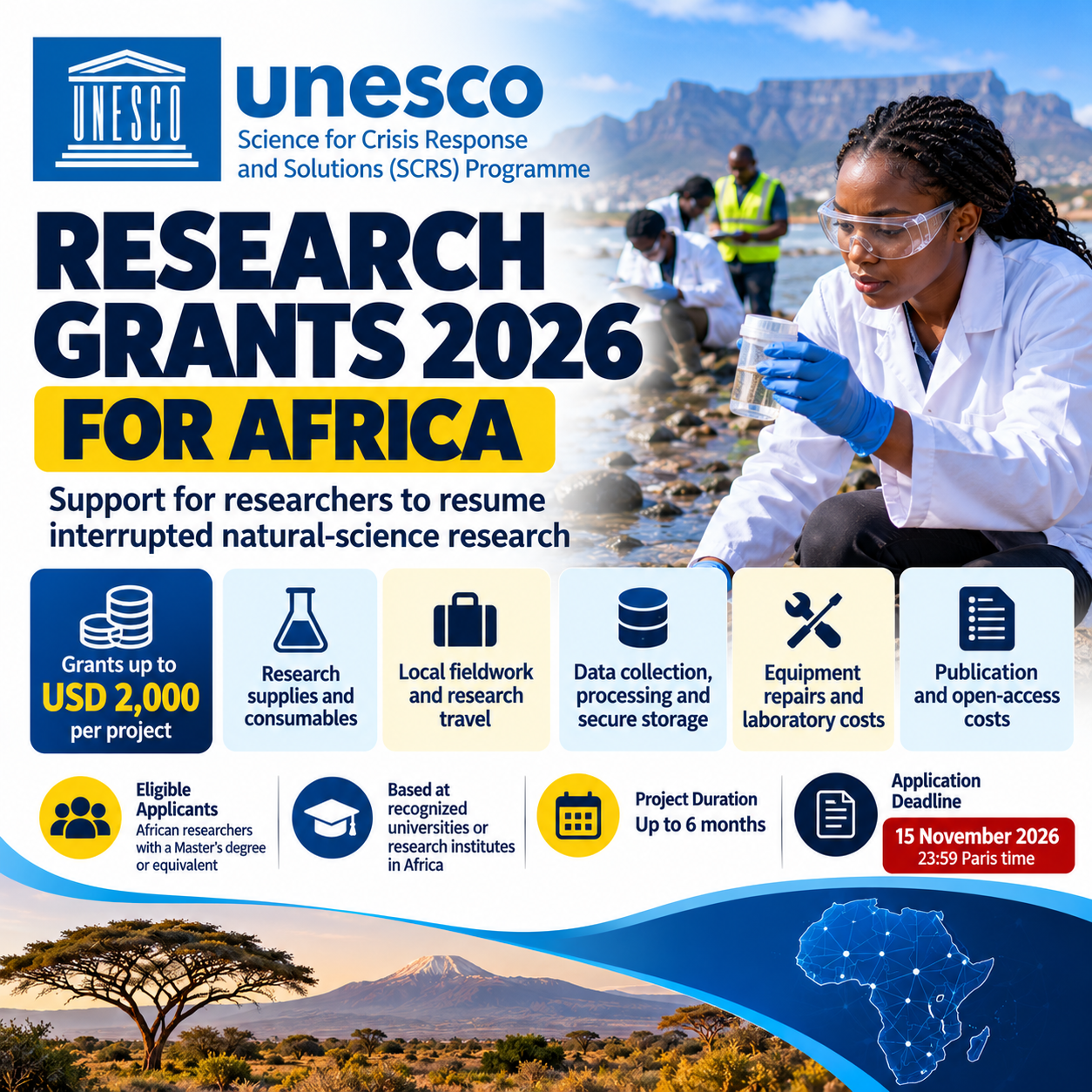
The programme will provide six institutional grants of up to USD $2,000 each to eligible researchers affiliated with recognized universities or research institutes in African countries. Funding is intended for specific research activities that can be completed within six months.
The UNESCO research grants 2026 are particularly relevant to scientists who have experienced disruptions caused by armed conflict, natural disasters, or biological hazards within the past three years, or whose research remains materially affected by these events.
Applications must be submitted by 15 November 2026 at 23:59 Paris time. Eligible researchers should review the requirements and prepare the necessary documents before applying.
UNESCO Research Grants 2026: At a Glance
| Opportunity Detail | Information |
|---|---|
| Programme | SCRS Research Continuity Grants for Africa |
| Organiser | UNESCO |
| Grant value | Up to USD $2,000 per grant |
| Number of grants | Six institutional grants |
| Eligible region | African countries meeting the crisis criteria |
| Eligible applicants | African national researchers based in Africa |
| Minimum qualification | Master’s degree or equivalent recognized research qualification |
| Research areas | Natural sciences and qualifying interdisciplinary research |
| Project duration | Up to six months |
| Application deadline | 15 November 2026 |
| Application time | 23:59 Paris time |
| Application method | Online application |
| Official information | UNESCO Science for Crisis Response and Solutions |
About the UNESCO Research Continuity Grants
The UNESCO Science for Crisis Response and Solutions programme seeks to strengthen the contribution of science to crisis preparedness, response, recovery, and long-term resilience.
Scientific research can be severely affected when universities and laboratories experience disruptions caused by armed conflict, environmental disasters, or biological hazards. Researchers may lose access to laboratories, fieldwork locations, equipment, funding, and essential research data.
The UNESCO Research Grants 2026 initiative addresses these challenges by providing targeted financial assistance to researchers who need to resume or complete a clearly defined part of an interrupted project.
Rather than funding an entire research programme, the grants focus on practical activities that can be completed within six months and within the USD $2,000 funding limit.
The first pilot call plans to award six grants through eligible research institutions in Africa. By supporting continuity of scientific work, the initiative aims to preserve valuable knowledge, strengthen research capacity, and improve the resilience of scientific institutions operating in crisis-affected environments.
What Do the UNESCO Research Grants Cover?
Each selected project can receive up to USD $2,000 for eligible research-related expenses. Applicants should prepare a realistic budget that directly connects the requested funding to the interrupted research.
1. Research Supplies and Consumables
Funding may cover essential laboratory consumables, small research supplies, and materials needed to resume scientific activities.
2. Local Fieldwork and Research Travel
Researchers may request support for eligible local fieldwork and research-related travel necessary to complete the proposed activities.
3. Data Collection and Storage
The grant may support data collection, processing, and secure storage to help researchers preserve scientific information and continue their investigations.
4. Equipment Repairs and Facility Access
Eligible expenses may include minor equipment repairs or essential short-term access to research equipment and facilities.
5. Laboratory and Publication Costs
Funding may support eligible laboratory expenses, publication fees, and open-access costs associated with the interrupted research.
Applicants should note that the grant does not cover salary replacement, honoraria, personal allowances, international relocation, long-term subsistence, major equipment purchases, construction, institutional overheads, or unrelated activities.
The UNESCO research grants 2026 therefore suit applicants with a focused, achievable research plan rather than those seeking general living expenses or long-term project funding.
ALSO READ: World Bank Special Assistant Job Opens in Washington, DC-2026 Apply Now
FOR MORE JOB UPDATES AND INFORMATION
Join WhatsApp Group 35
Join WhatsApp Group 34
Join WhatsApp Group 33
Join WhatsApp Group 32
JOIN WhatsApp CHANNEL INTERNATIONAL CAREERS UPDATES
Who Can Apply for the UNESCO Research Grants 2026?
Applicants must satisfy the programme’s eligibility requirements.
Generally, candidates must:
- Be African nationals based at a recognized university or research institute in an African country.
- Hold at least a Master’s degree or an equivalent recognized research qualification in a relevant field.
- Conduct natural-science research, including interdisciplinary research with a substantial natural-science component.
- Demonstrate that their research was interrupted by armed conflict or a natural or biological hazard within the previous three years, or remains materially affected by its consequences.
- Propose research activities that can be completed within six months and the USD $2,000 grant ceiling.
- Provide a signed support letter from an authorized representative of their host institution.
- Confirm that the same costs are not being funded by another source.
The programme encourages applications from all eligible African countries. Women scientists, researchers under 40, researchers from least developed countries, and researchers from African Small Island Developing States are particularly encouraged to apply.
However, meeting the eligibility requirements does not guarantee selection. Applicants must demonstrate a clear research need and explain how the grant will help restore continuity.
Required Documents for the Application
Researchers should prepare the following supporting documents before starting their application:
- A completed and signed application form.
- An up-to-date CV.
- Proof of the highest relevant academic or research qualification.
- A signed institutional support letter.
- Relevant ethics approvals and research or fieldwork authorizations, where required.
Applicants should also prepare a concise description of the interrupted research, the proposed activities, the expected results, and a budget showing how the grant will be used.
A well-defined proposal should explain why the research was disrupted, what remains to be completed, and how the proposed activities can realistically be finished within six months.
How to Apply for the UNESCO Research Grants 2026
Interested researchers can follow these steps.
Step 1: Read the official documents. Review the call for applications, terms of reference, and concept note to understand the funding conditions and eligibility requirements.
Step 2: Complete the application form. Applications are available in English and French.
Step 3: Attach supporting documents. Include your CV, proof of qualifications, institutional support letter, and any required research authorizations.
Step 4: Prepare your budget. Ensure that all requested expenses are directly related to the interrupted research and remain within the USD $2,000 limit.
Step 5: Submit before the deadline. Complete the online application and submit it by 15 November 2026 at 23:59 Paris time.
For further details, visit the official UNESCO opportunity announcement.
Frequently Asked Questions
How much funding is available?
Six institutional grants of up to USD $2,000 each are planned under the pilot call.
Can undergraduate students apply?
Applicants must hold at least a Master’s degree or an equivalent recognized research qualification in a relevant field.
Can researchers from any African country apply?
The call welcomes applications from African countries that meet the programme’s crisis criteria, subject to the eligibility requirements.
What research areas are eligible?
Natural-science research is eligible, including interdisciplinary projects with a substantial natural-science component.
What is the application deadline?
The deadline is 15 November 2026 at 23:59 Paris time. Late applications will not meet the stated deadline.
Final Thoughts
The UNESCO Research Grants 2026 provide a targeted opportunity for African scientists seeking to continue research disrupted by conflict or natural or biological hazards. With up to USD $2,000 available per institutional grant, the initiative can help researchers purchase essential supplies, restore access to facilities, preserve data, and complete focused scientific activities.
Eligible researchers should carefully review the funding restrictions, obtain institutional support, and develop a practical six-month research plan before applying. The deadline is approaching, so preparing the required documents early is advisable.
Keywords: UNESCO Research Grants 2026, UNESCO grants for Africa, research grants for African scientists, science funding Africa 2026, research continuity grants, UNESCO SCRS programme, natural science research grants, African university research funding, crisis affected researchers, scientific research funding, small research grants Africa, UNESCO funding opportunities 2026